In the world of luxury sleep, bed linens are not mere fabric; they are the quiet architecture of a room. Hotels have long set the standard for tactile comfort, enduring performance, and a sense of serene luxury that guests remember long after check-out. For homeowners and hospitality professionals alike, translating that hotel-grade ethos into everyday spaces requires understanding what actually makes bedding durable, breathable, and beautifully behaved wash after wash.
This guide distills the essentials into clear choices: materials that perform under pressure, the weave that offers that coveted balance between softness and resilience, and finishing techniques that add longevity without sacrificing the sensorial pleasure of sleeping on a refined surface. We’ll also meet three influential figures from different eras whose contributions to textiles echo in today’s premium bedding—showcasing how tradition informs modern practice.
Material and weave fundamentals: what to demand
When selecting hospitality-grade bedding, the fiber content and weave are the two most consequential axes. The goal is a fabric that feels luxurious against the skin, remains durable after repeated laundering, and drapes elegantly on the bed. Our practical framework focuses on cotton, linen, and blends that have proven performance in hotel settings.
- Cotton remains the bedrock of hotel linen. Long-staple cotton fibers yield a smoother hand, improved luster, and greater strength. In many premium lines, 600-thread-count percale or sateen weaves are common because they deliver crisp, breathable surfaces (percale) or a softly luminous hand (sateen).
- Percale vs. sateen — Percale is a plain weave that reads crisp and cool, ideal for warm climates or guests who prefer a breathable surface. Sateen uses a satin weave that yields a silkier hand and a subtle sheen, often perceived as more luxurious in cooler environments.
- Thread count vs. fabric weight — For hotel-grade linens, thread count alone is not a panacea. A high-quality 300–600 t.c. cotton, when paired with a proper weight and weave, can outperform a higher t.c. fabric that uses lower-quality fibers or looser construction. Look for density that translates into a cohesive fabric with durable edges and a stable hand.
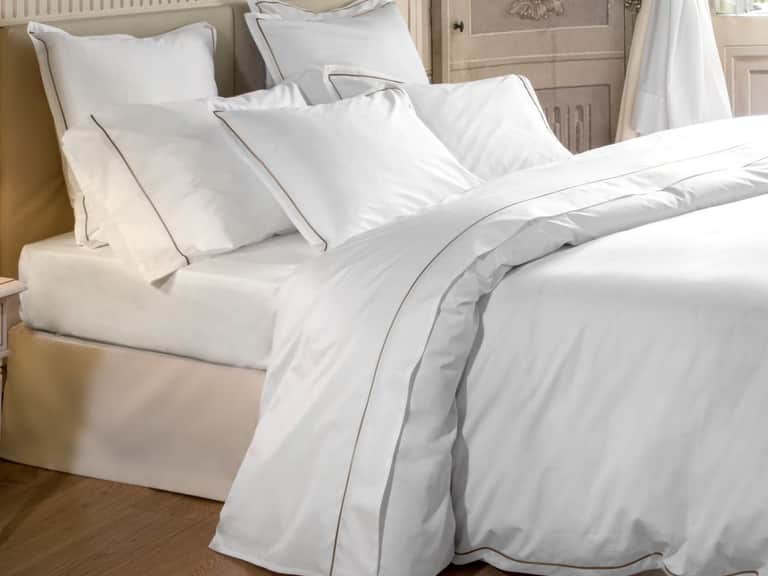
- Finishes and plissés — Finishes like hemstitching, knife-edge hems, and subtly tailored edges add durability and a refined silhouette without compromising washability. Finishes should be executed with care to avoid surface roughness or snag-prone textures.
Care and maintenance: keeping hospitality-grade textiles pristine
Durability begins with the care routine. Hotel linens are engineered to withstand frequent washing at higher temperatures while preserving color, shape, and softness. The following guidelines reflect best practices that balance hygiene, fabric integrity, and guest comfort:
- Washing temperatures — Many hotel-grade linens tolerate warm to hot cycles (60–90°C/140–194°F) for sanitation, but always follow fabric care labels. A gentle warm wash is typically sufficient for regular domestic use, while institutional environments may require higher temperatures.
- Detergents and additives — Use mild detergents and avoid fabric softeners or chlorine bleach that can degrade fibers and reduce wicking properties over time. For whites and pale fabrics, occasional non-chlorine bleach can be acceptable, but test on a small area first.
- Drying and storage — Tumble-dry on moderate heat or line-dry when possible to minimize heat wear. Remove promptly to reduce wrinkling and to maintain crisp drape. Store linens in a cool, dry place away from direct sunlight to prevent color fade.
- Frequency of laundering — In hospitality, turnover can be rapid; households can translate the same logic by rotating sets, ensuring consistent wash schedules to prevent wear clustering in one set. Rotate colors and patterns to distribute wear evenly across top-of-bed ensembles.
Hospitality standards and hotel-grade benchmarks
Hotel standards blend durability, cleanliness, and guest comfort into a coherent system. Several benchmarks help professionals compare and select bedding that aligns with these goals:
- Durability metrics — Look for fabrics described as robust, with high-twist yarns, dense weaves, and reinforced edges. Dimensional stability and resistance to pilling after multiple washes are key indicators.
- Breathability and moisture management — Percale tends to feel cooler and crisper, while sateen provides warmth and a luxurious hand. For hotels in humid or warm climates, breathable fabrics with good moisture management are crucial to guest comfort.
- Colorfastness and appearance retention — Colors should remain vivid after repeated cycles. Sateen weaves with dye-fast finishes and long-staple fibers typically maintain color better over time.
- Care label clarity — Clear care instructions support consistent maintenance across housekeeping teams, reducing mis-care or over-washing that could reduce fabric life.
Ethical sourcing and sustainability
Hospitality-grade bedding can be a touchstone for responsible luxury. Sourcing practices, fiber selection, and supply-chain transparency contribute to both social good and product longevity. Ethical considerations include:
- Traceable supply chains that reveal mills and regions, ensuring workers are treated fairly and environmental standards are upheld.
- Raw materials with long-staple fibers that endure frequent washing without excessive wear or micro-damage.
- Low-impact dyeing and finishing processes that minimize water usage and chemical impact while preserving color performance.
Three key individuals across time who shaped luxury textiles
Scrupulous editors note that textiles are not merely materials but narratives woven through centuries. Here are three influential figures from distinct eras whose legacies echo in the design and execution of today’s hospitality-grade linens.
1) Florence Nightingale (19th century) — The nurse who elevated linen ethics
Though famous for nursing, Nightingale’s era witnessed a transformation in hospital hygiene and standards that rippled into modern textile care protocols. Her insistence on cleanliness, organization, and evidence-based practice underscored the importance of fabric integrity and laundering discipline in healing environments. In hotel terms, this lineage translates to a meticulous attention to linen turnover, wash cycles, and uniform care protocols that ensure comfort and hygiene without compromising longevity.
2) William Morris (late 19th – early 20th century) — Arts and crafts as a standard for textile beauty
As a champion of handcrafted surface design, Morris infused textiles with durability and beauty. His approach to patterns, damasks, and natural dyes informs contemporary hospitality linens that balance visual richness with practical durability. The moral: textiles can be richly decorated yet incredibly robust, a principle at the heart of hotel-grade ensembles that need to resist wear while remaining visually refined.
3) Elsbeth and Luigi Signoria (20th–21st century) — Italian textile craft as a modern benchmark
In a contemporary Italian context, family mills and modern textile houses translating classic Italian craftsmanship into premium bedding epitomize the intersection of heritage and innovation. The Signoria Firenze lineage, as reflected in many elegant bedding lines, demonstrates how Italian weaving and finishing traditions can yield durable, luxurious linens that perform under hotel workloads while still feeling intimate for home use.
Product spotlight: Tuscan Dreams Pillowcases
Tuscan Dreams Pillowcases
Made in Italy from 100% Extra Long-Staple SUPIMA cotton percale with a refined hemstitch finish. A 400-thread-count confection, the pillowcases offer lasting softness and a refined edge that elevates any sleep space.
Sizes: Standard and King
Colors: Three-color options and white
Price: $190.00
Note: The Tuscan Dreams Pillowcases are highlighted here for their exemplary balance of luxury textile science and Italian craftsmanship. They illustrate how foundational materials—SUPIMA cotton, percale weave, and hemstitch finishing—translate into a practical, hotel-ready accessory for the home.
Editorial takeaway
Hospitality-grade bedding is the product of deliberate material choices, architectural weaving, and discipline in care. It’s not merely the fabric that matters; it is how the fabric behaves as part of a broader system—the sheet, the duvet cover, the pillowcases, and their maintenance routine. With thoughtful selections, you can achieve hotel-quality comfort without compromising the warmth, character, or story of your own space.